
Shopping Cart
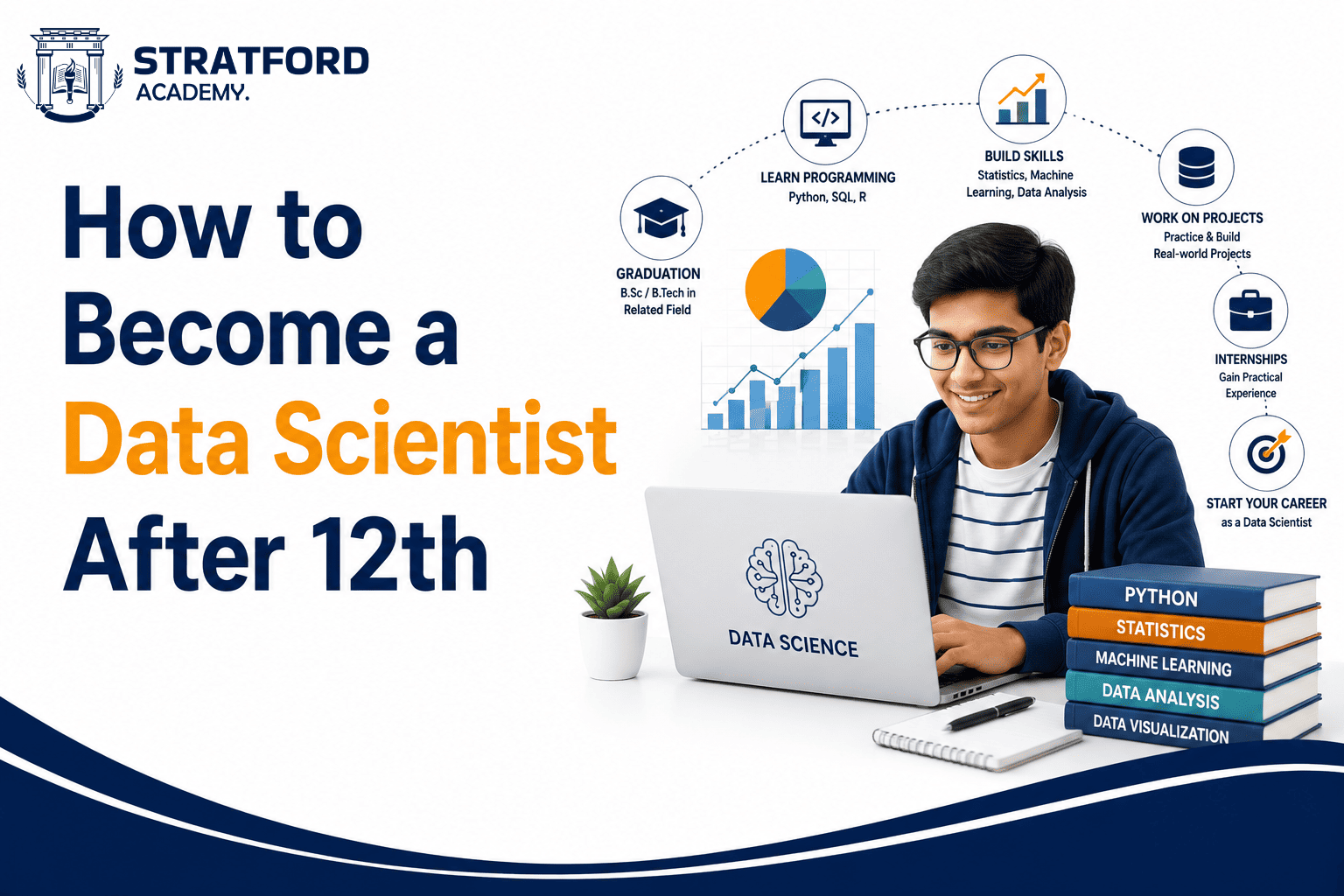
How to Become a Data Scientist After 12th
 Bookmark
Every online order, hospital record, bank payment, sports score, and government service creates data. Businesses use it to forecast demand, reduce fraud, improve products, and make better decisions. If you’re asking How To Become A Data Scientist After 12th, you don’t need to know every programming language today. You need a steady plan built on mathematics, coding, statistics, projects, and clear communication.
Data science combines mathematics, statistics, programming, machine learning, artificial intelligence, and subject knowledge. IBM describes a typical workflow as collecting, cleaning, analysing, modelling, and communicating data. Your path may begin with a degree, but it becomes credible through practical work.
How to Become a Data Scientist After 12th: Build the Foundation
Choose a stream that supports your goals
Science with Mathematics gives you the strongest early base for probability, statistics, calculus, and linear algebra. Computer Science or Informatics Practices can also help you learn coding and problem-solving sooner. Still, Science isn’t the only route.
Commerce students can build strong skills in statistics, business, economics, and finance. Students from other streams can also enter the field by studying mathematics and programming alongside college. If you didn’t take Mathematics in Classes 11 and 12, complete a foundation course before advanced machine learning study.
Strengthen maths, reasoning, and programming
Focus on arithmetic, algebra, functions, probability, statistics, matrices, basic calculus, and data interpretation. Logical reasoning helps you design algorithms, find coding errors, test ideas, and explain decisions. Keep a topic-wise practice plan using school texts, trusted online courses, and problem-solving sites.
Python is the best starting language for most beginners. Learn variables, conditions, loops, functions, lists, dictionaries, file handling, basic object-oriented programming, and error handling. Write small programs such as a calculator, expense tracker, data summary tool, or text analyser. Learn SQL as well, since data teams use it to retrieve information from databases.
Choose a Degree That Opens the Door to Data Science
Compare undergraduate degree options
Common Indian routes include B.Tech or B.E. in Computer Science, Data Science, Artificial Intelligence, Machine Learning, Information Technology, Mathematics, or Statistics. B.Sc. degrees in Data Science, Statistics, Mathematics, or Computer Science can work too. BCA is another option, especially when you add strong mathematics, Python, SQL, projects, and later specialisation.
Check eligibility carefully because colleges set different rules for subjects, marks, and entrance tests. A degree title alone won’t create a data science career. Course content, faculty, labs, internships, projects, and placement support matter more.
Check the college before enrolling
Read the full syllabus. Look for mathematics, statistics, programming, databases, machine learning, visualisation, software development, and communication. Also check accreditation, faculty backgrounds, lab access, industry links, internships, alumni outcomes, and placement reports.
Compare at least three programmes using the same checklist. Don’t choose based only on advertising or a course name containing “AI.” The official NIRF 2025 engineering rankings can provide one comparison point, but rankings shouldn’t replace syllabus and placement research.
Consider postgraduate study when it adds value
An M.Sc. or M.Tech. in Data Science, Statistics, Artificial Intelligence, Machine Learning, or Computer Science can strengthen your foundation. It may help if you want to change fields, build research skills, enter specialised roles, or qualify for more academic and industry positions.
Students from mathematics, statistics, economics, engineering, and computer science often use postgraduate study to focus their careers. It isn’t compulsory for every role. Choose it when the programme offers strong teaching, research, projects, and links with employers.
Develop the Technical Skills Employers Expect
Learn tools for data work
Learn NumPy, pandas, and SciPy in Python. Practise with CSV files, JSON, spreadsheets, APIs, database tables, and public datasets. You must know how to handle missing values, duplicates, wrong data types, inconsistent formats, and outliers.
SQL should include filtering, sorting, joins, grouping, subqueries, and window functions. Learn Git and GitHub to track changes, share code, and document your work. IBM also lists Python libraries, Jupyter Notebooks, GitHub, visualisation tools, and machine learning frameworks among common data science tools in its data science guide.
Build statistics and machine learning knowledge
Study descriptive statistics, probability, sampling, distributions, correlation, regression, hypothesis testing, confidence intervals, and experiment design. Then learn supervised methods such as linear regression, logistic regression, decision trees, random forests, and support vector machines. Unsupervised learning includes clustering, dimensionality reduction, and anomaly detection.
Understand train-test splits, cross-validation, suitable metrics, overfitting, underfitting, bias, and variance. Learn the assumptions and limits of each method instead of memorising model names. A simple model with clean data and a sound question often beats a complex model with weak reasoning.
Present findings with clear visuals
Use Matplotlib, Seaborn, Plotly, Excel, or business intelligence tools when suitable. Select charts based on the question, audience, data type, and decision being made. A dashboard should have clear labels, useful filters, readable scales, and short explanations.
Avoid distorted axes, decorative charts, crowded screens, and claims the data cannot support. Explain what happened, why it may have happened, and what action the evidence supports. Communication matters because data scientists work with managers, engineers, analysts, researchers, and clients.
Turn Learning Into Proof Through Projects
Select projects with a clear purpose
Choose a question that someone could act on. Useful ideas include customer segmentation, demand forecasting, recommendation systems, fraud detection, sentiment analysis, anomaly detection, and predictive modelling. You could study public transport use, online retail orders, sports performance, hospital readmissions, or rainfall patterns.
Use datasets from government open-data portals, academic repositories, or established competition platforms. Don’t copy a tutorial and change the title. Add your own question, analysis, comparison, or improvement, then explain who could use the result.
Document the full workflow
A strong project shows problem definition, data collection, cleaning, exploration, feature creation, model choice, evaluation, interpretation, and recommendations. Compare a basic baseline with more complex models. This shows whether extra complexity improves results.
Publish a clear README, organised notebooks or scripts, dependency details, charts, results, limitations, and next steps. Add a short business summary without technical terms. Keep three to five finished projects instead of many unfinished notebooks.
Place code and documentation on GitHub. Add project summaries to a personal site or professional profile, and use competition platforms as extra evidence of practice. Be ready to discuss data quality, model selection, errors, trade-offs, and limits in an interview.
Gain Experience and Move Toward Employment
Find internships and practical experience
Look for internships, research assistant roles, college projects, hackathons, open-source work, student clubs, and supervised freelance tasks. Target work in data analysis, business intelligence, reporting, Python automation, research, or machine learning support. Tailor each application to the job description and show one or two relevant projects.
Check the mentor, learning goals, work hours, payment, data access, and project terms before accepting an internship. A real project with feedback can teach more than another certificate. India’s education policy also supports AI and data science learning; a 2026 PIB backgrounder on AI in education notes AI options in CBSE and more than 110 free AI courses on SWAYAM.
Apply for realistic entry-level roles
“Data scientist” may not be your first job title. You could begin as a data analyst, business analyst, research analyst, junior data scientist, machine learning intern, business intelligence analyst, or data engineer trainee.
Analyst roles build SQL, reporting, data interpretation, and stakeholder skills. Engineering roles focus more on pipelines, databases, and software. Research roles may involve experiments, statistics, papers, and model testing. Judge a job by its duties and learning value, not its title alone.
Prepare for interviews and growth
Practise Python, SQL, statistics, machine learning, case studies, data interpretation, project discussion, and common behaviour questions. Explain why you chose a method, how you measured success, what failed, and what you would change. Show that you understand privacy, bias, fairness, and responsible data use.
Later, you can specialise in finance, healthcare, marketing, business analytics, machine learning engineering, natural language processing, computer vision, cloud systems, or data engineering. Keep learning through work, projects, mentors, and focused courses.
Follow a Practical Roadmap From Class 12 to Employment
Build fundamentals first
After Class 12 and during early college, focus on mathematics, statistics, Python, SQL, spreadsheets, and basic visualisation. Complete small projects and save them on GitHub. Avoid collecting machine learning certificates before you understand the basics.
Build applied skills next
During later college years, study databases, machine learning, experiments, model evaluation, and software practices. Complete realistic projects, join competitions, seek internships, and practise technical interviews. Improve your writing and speaking at the same time.
Specialise and apply with evidence
Before graduation, choose an area that matches your interests and available opportunities. Refine your resume, online profile, GitHub repositories, and project presentations. Apply for suitable internships and entry-level roles, then use interview feedback to close skill gaps.
Conclusion:
Becoming a data scientist after 12th is a multi-stage process, not a single course or certificate. Build mathematics, statistics, Python, SQL, visualisation, machine learning, communication, and ethical reasoning. Choose a degree for its curriculum and opportunities, then prove your ability with well-documented projects and practical experience.
You don’t need to know everything at once. Start with one maths topic, one Python lesson, and one small dataset this week. Consistent practice can turn your Class 12 starting point into a credible data science career.

Leave a Comment
Your email address will not be published. Required fields are marked *
Comments
Comments section can be added here for reader engagement.